



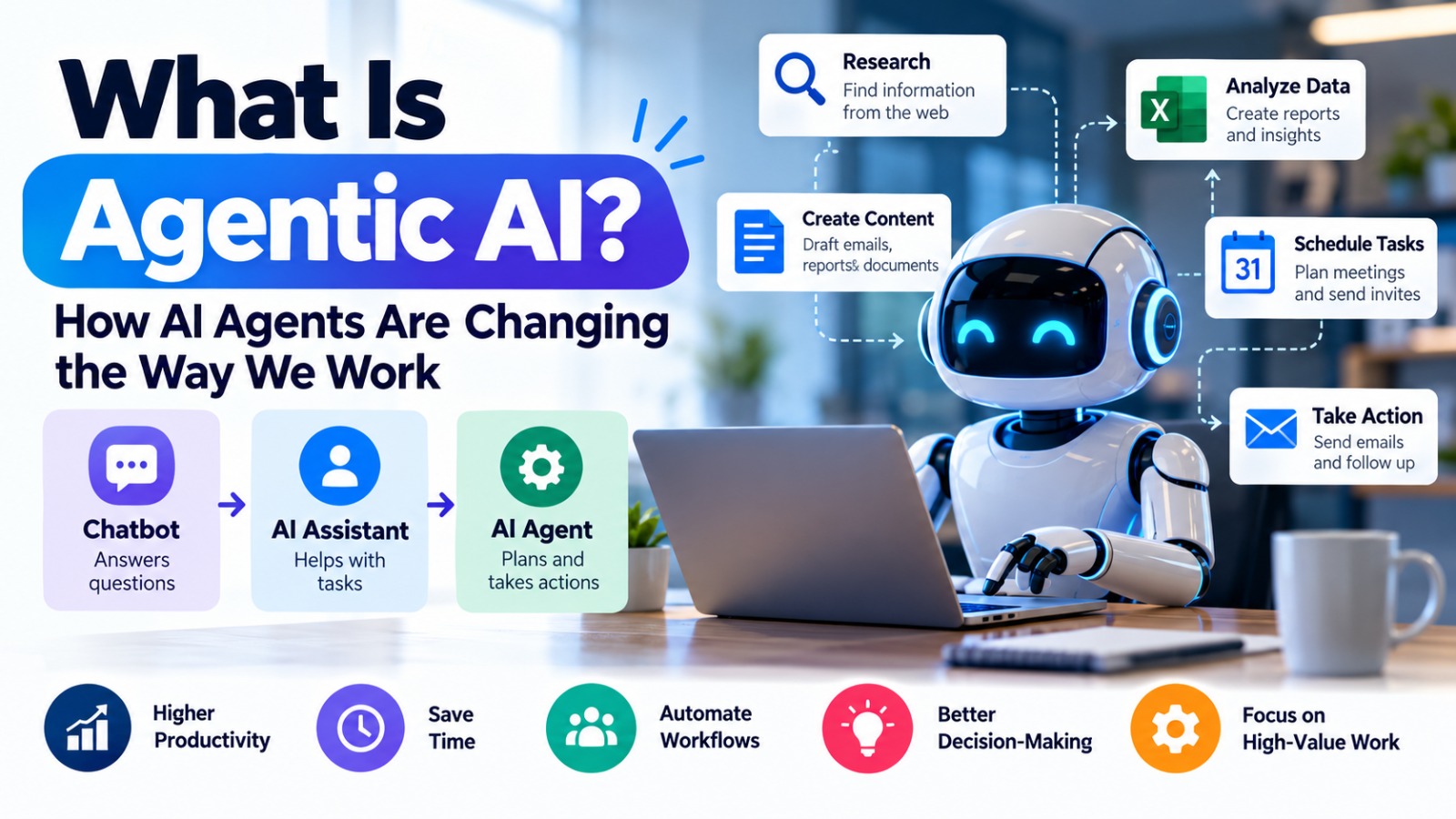
Artificial Intelligence is evolving beyond answering questions and generating content. Today, AI systems can also plan tasks, use tools, and perform multiple actions to achieve specific goals. This development is known as Agentic AI.
From business automation to data analysis, AI agents are changing how professionals work and manage everyday tasks.
What Is Agentic AI?
Agentic AI refers to AI systems that can understand a goal, plan the steps required, use connected tools, and execute tasks with a degree of autonomy.
For example, instead of simply explaining how to prepare a sales report, an AI agent could retrieve authorized data, analyze performance, create a summary, and prepare a report.
The exact capabilities depend on the tools, permissions, and instructions provided to the agent.
Chatbot vs AI Assistant vs AI Agent
Although these technologies can overlap, their typical roles are different.
- Chatbot: Answers questions and responds to user messages.
- AI Assistant: Helps with tasks such as writing emails, summarizing documents, and analyzing information.
- AI Agent: Can plan and execute multiple steps toward a goal using available tools.
Example: A chatbot explains how to organize a meeting. An AI assistant drafts the agenda. An AI agent with calendar access could identify suitable time slots and arrange the meeting, subject to the required permissions and approvals.
How Do AI Agents Work?
AI agents generally follow a simple process:
- Understand: Identify the user’s goal.
- Plan: Break the task into smaller steps.
- Act: Use tools and connected applications.
- Check: Evaluate the results and handle errors where possible.
- Deliver: Provide the completed work or requested output.
Human approval may be necessary before important actions are performed.
Real-World Applications of Agentic AI
AI agents can support different business functions:
- Sales and marketing: Research leads, analyze campaigns, and draft follow-up messages.
- Data analytics: Analyze sales figures, identify trends, and prepare reports.
- Customer service: Retrieve order information and prepare responses to customer queries.
- Human resources: Organize applications and coordinate interview scheduling.
- Finance: Compare invoices, identify discrepancies, and prepare reconciliation reports.
- Software development: Assist with writing code, testing, and debugging.
These applications can reduce repetitive work and help employees focus on more valuable activities.
What Are the Benefits of Agentic AI?
Some potential benefits include:
- Improved productivity and reduced manual effort.
- Faster completion of multi-step tasks.
- Better coordination between business applications.
- More time for strategic and creative work.
- Opportunities to automate repetitive workflows.
However, AI agents can make mistakes and may require additional setup, monitoring, and technical resources. Businesses should protect sensitive information and require human approval for important decisions or high-impact actions.
Which Skills Are Useful for Learning Agentic AI?
Professionals interested in this emerging technology can begin by learning:
- Generative AI tools and prompt engineering.
- Workflow automation and application integrations.
- Excel, SQL, and Power BI for data analysis.
- Python programming and APIs for advanced development.
- AI evaluation, security, and responsible use.
Beginners can start with existing AI tools and no-code automation platforms before progressing to custom AI agent development.
The Future of Agentic AI
Agentic AI is moving technology beyond generating answers toward completing tasks. Businesses are exploring its use in reporting, customer service, research, software development, and workflow automation.
Although adoption and capabilities will vary, understanding AI tools, automation, and data skills can help professionals prepare for changing workplace requirements.
Conclusion
Agentic AI is an important development in artificial intelligence because it enables systems to plan and coordinate multiple actions toward a defined goal. When implemented responsibly, AI agents can help businesses improve productivity and simplify complex workflows.
At Compusoft Education, we help students, working professionals, and corporate teams develop practical AI and digital skills for the modern workplace.
Visit Compusoft Education to explore our training programs.
Frequently Asked Questions (FAQs)
- What is Agentic AI in simple words?
Agentic AI is AI that can plan and perform multiple steps toward a goal using available tools.
- What is the difference between Generative AI and Agentic AI?
Generative AI creates content such as text, images, and code. Agentic AI uses AI capabilities to plan and coordinate actions toward an objective.
- Can AI agents automate business tasks?
Yes. Depending on their configuration, they can assist with reporting, research, customer support, and workflow automation.
- Do I need coding skills to learn Agentic AI?
No. Beginners can explore ready-made tools and no-code platforms. Python and API knowledge are useful for building advanced custom agents.
- Is Agentic AI worth learning in 2026?
It is a promising area to explore. Practical AI knowledge, automation skills, and real-world projects can help professionals prepare for evolving workplace needs.